


Search on the internet is gradually becoming more than just a list of links. Users increasingly formulate complete questions: they ask for product recommendations, comparisons, availability checks, delivery conditions, or help finding the right category. The answer may be generated by an AI system before the user even visits the website.
For an online store, this creates a new technical challenge. Having correct HTML, a Sitemap, and traditional SEO is no longer enough. Store data should also be available in a format that automated systems can discover, read, and interpret unambiguously.
This is exactly the task addressed by AI Discovery for PrestaShop.
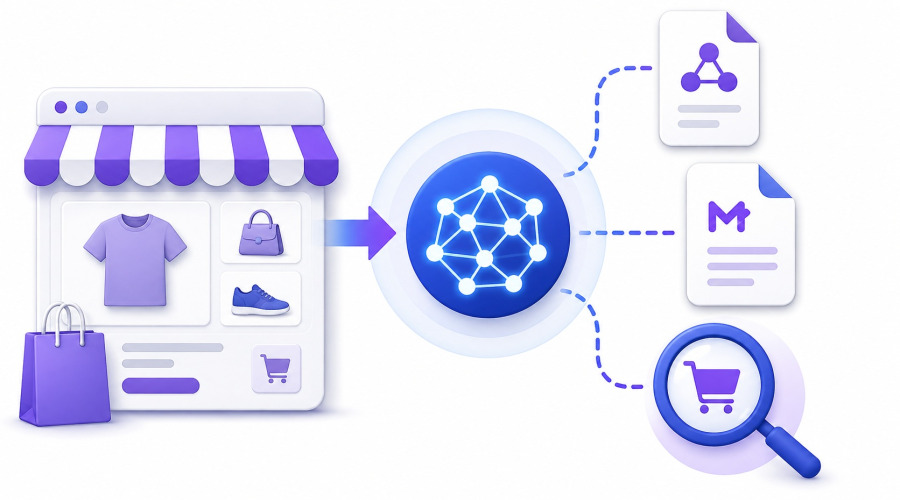
The module creates an additional machine-readable layer on top of a standard PrestaShop store: llms.txt, Markdown representations of products and pages, a structured catalog of AI resources, and a mechanism for discovering these resources from regular HTML pages.
It is important to define the limits of the technology from the start: AI Discovery does not guarantee that a store will appear in ChatGPT, Claude, Gemini, or any other AI system. No module can provide such a guarantee. The final decision about crawling, indexing, and using a page remains with each AI provider.
The purpose of the module is different: to make the public information of an online store as accessible and unambiguous as possible for AI systems that can work with web content and corresponding discovery mechanisms.
Why a regular website is no longer enough
A PrestaShop product page is designed primarily for people and browsers. In addition to useful product information, it may contain:
- site header;
- navigation menu;
- filters;
- recommendation blocks;
- banners;
- navigation elements;
- JavaScript;
- cart elements;
- theme components;
- dozens or hundreds of HTML nodes unrelated to the product itself.
Modern search engines can parse such documents. AI agents can do the same, but the more irrelevant context surrounds the important data, the harder it becomes to determine which information actually belongs to the product.
For a product page, an AI system is primarily interested in a clear set of facts:
Name
Canonical URL
SKU
Manufacturer
Category
Price
Currency
Availability
Description
Features
Combinations
Images
AI Discovery creates a separate compact representation for these entities.
For example:
/en/ai/product/123.mdInstead of a full HTML page, an agent can receive a document with a structure such as:
# Eureka Mignon Specialita Coffee Grinder

Canonical:
https://example.com/eureka-mignon-specialita.html

## Product

SKU: EUR-MIGNON-S
Brand: Eureka
Category: Coffee Grinders

Price: 48900 RUB
Availability: In stock

## Description

...

## Specifications

- Burr diameter: 55 mm
- Power: 310 W
- Grinding adjustment: Stepless

## Variants

...

## Images

...
The normal product page continues to work exactly as before. Markdown does not replace HTML and is not generated instead of it. It is an additional representation of the same public data.
What is llms.txt
One of the technologies used by the module is llms.txt.
It is a proposed text-file format intended to describe the structure of a website for language models and AI tools.
According to the specification, the document can be available at:
https://example.com/llms.txtand use Markdown formatting. A typical document starts with an H1 heading containing the project or website name, followed by a short description and sections linking to important resources.
Example for an online store:
# Example Store

> Online store for professional coffee equipment.

## Catalog

- [Coffee Grinders](https://example.com/ai/category/12.md)
- [Coffee Machines](https://example.com/ai/category/18.md)

## Information

- [About Us](https://example.com/ai/cms/4.md)
- [Delivery](https://example.com/ai/cms/7.md)
- [Contact](https://example.com/ai/page/contact.md)
llms.txt itself is not an official internet standard on the same level as robots.txt, Sitemap, or Schema.org. Therefore, it would be technically incorrect to claim that every AI system is required to read it.
This is why AI Discovery is not built around llms.txt alone.
Multiple layers of AI Discovery
The module creates several types of resources.
llms.txt
A compact map of the most important sections of the store:
/llms.txtIt is intended to explain the site structure rather than export tens of thousands of products.
llms-full.txt
An extended representation:
/llms-full.txtIt can contain more information about the catalog, brands, selected pages, and overall store structure.
Machine-readable catalog
The module also generates:
/ai/catalog.jsonThis document describes available AI resources and URL templates.
For example:
{
  "resources": {
    "llms": "/llms.txt",
    "llms_full": "/llms-full.txt",
    "home": "/ai/home.md",
    "product_template": "/ai/product/{id}.md",
    "category_template": "/ai/category/{id}.md"
  }
}
This JSON catalog is not part of the llms.txt proposal. It is an additional discovery mechanism provided by the module.
Markdown for products
Products receive their own Markdown documents:
/ai/product/123.mdThe module retrieves data directly from PrestaShop and creates a deterministic representation.
It can include:
- product name;
- canonical URL;
- reference/SKU;
- manufacturer;
- default category;
- public price;
- currency;
- availability;
- short description;
- full description;
- product features;
- combinations;
- images.
The module does not use generative AI to create these data.
This is an important architectural principle.
The flow is:
PrestaShop
    ↓
Data normalization
    ↓
Markdown
not:
PrestaShop
    ↓
LLM
    ↓
Generated description
AI Discovery does not invent product characteristics, add marketing claims, or change factual information stored in the shop.
Product combinations
This is particularly important for PrestaShop.
A single product may contain variants such as:
Size S / Red
Size S / Green
Size M / Red
Size M / Green
Each combination may also have its own:
- SKU;
- price;
- EAN;
- UPC;
- MPN;
- stock quantity.
AI Discovery can expose this structure inside the product Markdown so that automated systems do not treat every variation as one abstract product.
Markdown for categories
Categories receive their own URLs:
/ai/category/9.mdThe document can include:
- category name;
- canonical URL;
- description;
- relevant products.
Links inside the AI category can lead first to the Markdown representation of each product:
category.md
     ↓
product.md
     ↓
canonical HTML
This allows an AI agent to move through the machine-readable catalog and then follow the canonical storefront page when needed.
<h2class="mt-4 >Manufacturers
The same principle applies to brands:
/ai/manufacturer/12.mdThe document can contain:
- manufacturer name;
- canonical URL;
- description;
- products from that brand.
This is particularly useful for questions such as:
Which products from brand X are available in this store?
CMS pages
Not all useful information in an online store belongs to the catalog.
An AI system may need to understand:
- delivery conditions;
- payment methods;
- return policies;
- warranty;
- company information;
- FAQ.
In PrestaShop, this content is usually stored in CMS pages.
AI Discovery allows the merchant to choose which CMS pages should receive a Markdown representation.
For example:
/content/4-about-uscan receive:
/ai/cms/4.mdCMS pages that are not selected remain unavailable through the AI endpoint.
PrestaShop system pages
PrestaShop also has another class of public pages that are not CMS pages:
contact
prices-drop
new-products
best-sales
stores
manufacturer
supplier
For example:
/contact-usor:
/prices-dropThese pages are generated by PrestaShop controllers and described through Meta.
AI Discovery allows the store administrator to select which system pages should be exposed to AI systems.
They receive URLs such as:
/ai/page/contact.md
/ai/page/prices-drop.md
/ai/page/new-products.md
Potentially private pages such as the cart, checkout, customer account, order history, addresses, and authentication pages are intentionally excluded.
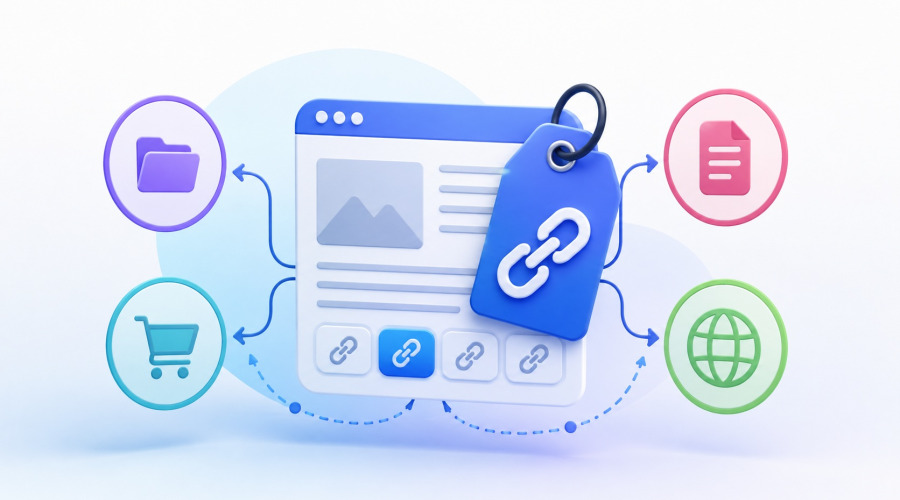
HTML Discovery
One of the most important module features is the connection between the ordinary website and its AI-readable representation.
On a product page, the module can add:
<link
    rel="alternate"
    type="text/markdown"
    href="https://example.com/ai/product/123.md"
>
This tells compatible clients:
This HTML page has an alternative Markdown representation.
The module can also add:
<link
    rel="describedby"
    href="https://example.com/llms.txt"
>
This allows a compatible AI agent to discover the website-level llms.txt.
The same principle can be applied to categories, manufacturers, CMS pages, and selected system pages.
AI Discovery does not replace robots.txt
The existence of llms.txt does not automatically mean that a particular crawler is allowed to access the website.
For example, OpenAI documents OAI-SearchBot for discovering public content that may appear in ChatGPT Search.
Access may also be blocked by:
- Cloudflare;
- WAF;
- anti-DDoS systems;
- CAPTCHA;
- rate limiting;
- firewall rules;
- hosting-level bot protection.
Therefore, the correct architecture is not:
llms.txt = website accessible to AIIt is:
public HTML
+
robots.txt
+
crawler accessibility
+
Sitemap
+
structured data
+
llms.txt
+
Markdown
Not a replacement for Schema.org
AI Discovery should also not be considered a replacement for JSON-LD or Schema.org.
A product page should still expose correct structured data such as:
Product
Offer
Brand
price
priceCurrency
availability
sku
gtin
Markdown solves a different problem: it provides a compact textual representation of the entity.
A modern store architecture therefore consists of several independent layers:
HTML                     → people and crawlers
Schema.org / JSON-LD     → structured data
Sitemap                  → URL discovery
robots.txt               → crawler access rules
llms.txt                 → AI-oriented site map
Markdown                 → compact page representation
These technologies do not compete with one another.
How does an AI system know the module is installed?
It does not.
And it does not need to.
An AI system does not care which PrestaShop module generated the resources, or whether any module is installed at all.
It only sees the public architecture:
https://example.com/llms.txt
https://example.com/ai/product/123.md
https://example.com/ai/category/9.md
and the discovery markup on the storefront pages.
This is an important architectural principle: AI Discovery does not require a direct integration with a particular AI provider.
There are no API keys for:
OpenAI
Anthropic
Google
Perplexity
The catalog is not uploaded to an external service.
No product data is automatically sent to a third party.
The module simply makes public store data available through additional HTTP resources.
ETag and 304 Not Modified
AI resources can also use the standard HTTP ETag mechanism.
A client may send:
If-None-Match: "abc123"If the document has not changed, the server can respond:
304 Not ModifiedThis avoids retransmitting the same Markdown document.
It is a standard HTTP optimization, but it becomes especially useful for automated crawler traffic.
Price and availability
A price in PrestaShop is not simply the value of product.price.
The final public price may depend on:
- taxes;
- Specific Price rules;
- combinations;
- currency;
- customer group;
- country;
- quantity.
Therefore, AI Discovery uses a defined public store context and PrestaShop's own pricing logic.
This is necessary to avoid exposing a raw technical price from the database that may not correspond to the actual storefront price.
For the same reason, an AI document should not depend on the cookies of an individual customer.
One public URL should return a predictable public representation.
Private data
AI Discovery works only with the public catalog.
AI resources must never expose:
Customers
Addresses
Orders
Carts
Customer messages
Employees
Sessions
Tokens
API credentials
The module also does not generate AI representations of pages such as:
Cart
Checkout
Customer account
Order history
Addresses
Login
Password recovery
This is not merely an optional setting. It is a fundamental architectural rule.
Why the module does not generate content with ChatGPT
The name of the technology may create the impression that the module itself must connect to an AI model.
It does not.
Generating:
llms.txt
Markdown
catalog.json
does not require an LLM at all.
In fact, sending product descriptions through a language model before publishing them would introduce additional problems:
- possible hallucinations;
- factual changes;
- dependency on an external API;
- API costs;
- latency;
- data-processing concerns.
AI Discovery follows a different principle:
PrestaShop remains the source of truth.
The module only transforms existing public information into a cleaner machine-readable format.
Support for all AI systems
This is where marketing claims need to remain technically accurate.
It would be incorrect to say:
“Install the module and your store will appear in every AI system.”
Different platforms use different crawlers, search indexes, retrieval systems, and policies.
For example, OpenAI documents OAI-SearchBot for public web discovery in ChatGPT Search.
Therefore, the task of a universal module is not to target one AI brand. It is to use independent web mechanisms:
HTTP
HTML
canonical
robots.txt
Sitemap
Schema.org
Markdown
llms.txt
This is why AI Discovery does not depend on a specific AI provider.
PrestaShop as the data source
The module works directly with native PrestaShop entities:
Product
Combination
Category
Manufacturer
CMS
Meta
Shop
Language
Currency
Stock
It uses standard PrestaShop module integration mechanisms rather than modifying the core platform.
Public AI endpoints are implemented as module front controllers, which allows the module to expose additional storefront URLs without replacing existing PrestaShop pages.
This architecture avoids unnecessary Core overrides for the basic functionality.
Which stores can benefit from this
AI Discovery is particularly relevant for stores with large amounts of structured product information:
- technical equipment;
- electronics;
- automotive parts;
- clothing and footwear with combinations;
- professional cosmetics;
- furniture;
- B2B catalogs;
- specialized products;
- stores with extensive product specifications.
The more important precise technical attributes are for product selection, the more valuable a compact machine-readable representation becomes.
However, even a small store benefits from having a consistent representation of:
the store
the catalog
products
informational pages
AI search does not replace the traditional online store, and it does not make conventional SEO obsolete.
But the web now has another important consumer of information: the AI agent.
An AI agent needs many of the same facts as a customer:
What is this store?
What does it sell?
What product is this?
How much does it cost?
Is it available?
What are its specifications?
Which variants exist?
Where can delivery, payment, and contact information be found?
The difference is how that information is delivered.
AI Discovery for PrestaShop creates an additional machine-readable layer on top of a standard store: llms.txt, Markdown resources, an AI resource catalog, and discovery mechanisms connected to normal storefront pages.
It does this without uploading the catalog to third-party services, without generating facts with an LLM, and without locking the store to a single AI provider.
The goal is not to predict which specific AI format will become dominant in the future.
It is to build an architecture in which online-store data is already accessible not only to people and traditional search engines, but also to a new class of software consumers — AI systems and AI agents.
Module >
